Qaqortoq
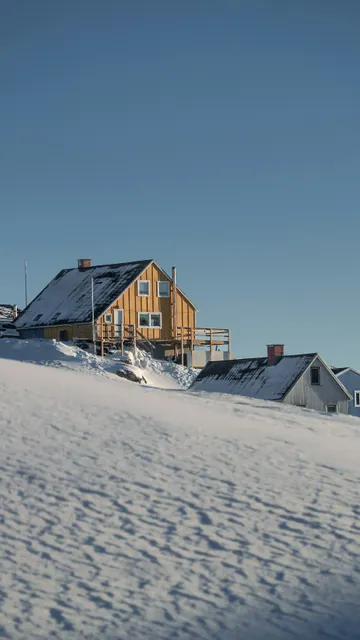
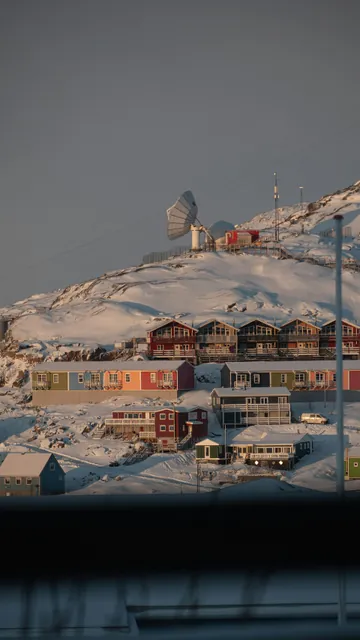
Qaqortoq is the largest town in South Greenland, with a population of around 3,000 people. It sits on a hillside overlooking a sheltered fjord at 60°N, roughly the same latitude as Lerwick in Shetland. While further south than most Greenlandic aurora destinations, its position still falls within range of the Northern Lights during periods of moderate to strong geomagnetic activity, and the near-total absence of light pollution means even modest displays show well.
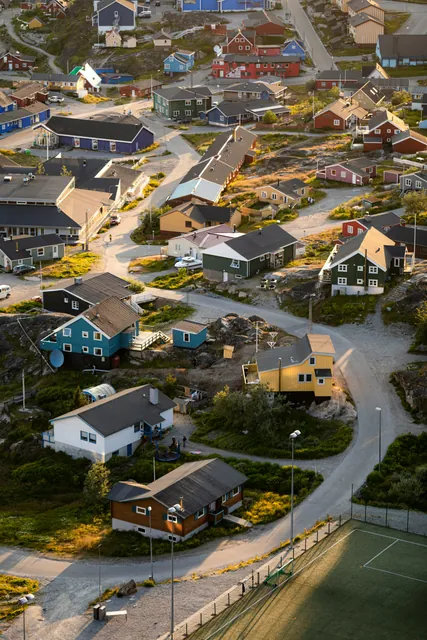
The town is known for its colourful houses stacked along the hillside and its open-air art project, Stone and Man, in which artists from across the Nordic countries have carved sculptures into rocks throughout the town. The small but engaging Qaqortoq Museum covers the region’s Norse and Inuit history, and the town’s central square, with its fountain (the only one in Greenland), is the social heart of the community.
South Greenland has a fascinating cultural landscape. The ruins of Hvalsey Church, a short boat ride from Qaqortoq, are the best-preserved Norse ruins in Greenland and the site of the last recorded event in Norse Greenlandic history, a wedding in 1408. Hot springs at Uunartoq, on a nearby island, offer the chance to bathe in naturally warm water surrounded by icebergs and mountain views.
Getting to Qaqortoq requires a flight via Nuuk or Narsarsuaq, or the Arctic Umiaq Line ferry along the coast. The remoteness is part of the appeal, South Greenland sees far fewer visitors than the west coast, and the pace of life is unhurried. Boat trips among the fjords, hiking in the surrounding hills and visits to nearby farming settlements offer a glimpse into a way of life that has changed remarkably little.
-
-
Credit: Pipaluk Nielsen
-
Credit: Pipaluk Nielsen
How are my chances of seeing the aurora today?
Many factors contribute to your likelihood of viewing the aurora in Qaqortoq. Geomagnetic activity, cloud cover and the amount of ambient light all play a big part. Check the forecasts for how good the viewing conditions are today.
Aurora Probability and Atmospheric Conditions
13%
There is a 13% chance of seeing the aurora overhead in the Qaqortoq area (forecast for 9 October 2026 at 7:11am UTC)
Kp 3.33
The Kp-index is a scale used to measure geomagnetic activity. It ranges from 0 to 9, with higher values indicating greater geomagnetic activity.
- 0-2 (Very low) Far north, quite dim, and not very active.
- 3-5 (Moderate) Can be seen further south, with increased brightness and activity. Chance of good viewing conditions nearer the pole.
- 6-7 (High) Visible in many northern regions, with vibrant displays.
- 8-9 (Extreme) Widespread visibility, often seen in areas much further south than usual, with intense and colorful displays.
HPI 35 GW
The Hemispheric Power Index (HPI) is a vital measure used to assess the strength of auroral activity at the poles. It estimates the total auroral energy input, with values above 20 GW indicating an aurora-active state. When the HPI reaches levels of 100 GW or more, it signifies a very significant geomagnetic storm, which can lead to spectacular auroral displays.
Bz -4 nT
Bz refers to the north-south orientation of the magnetic field embedded in the solar wind. It is measured in nanoteslas (nT).
When Bz is negative (southward), it allows solar wind particles to penetrate the Earth’s magnetic field more easily. A strong negative Bz is often associated with increased chances of seeing the Northern Lights.
Conversely, when Bz is positive (northward), the Earth’s magnetic field tends to block the solar wind, resulting in reduced aurora activity.
Bt 6 nT
Bt measures the overall power of the Interplanetary Magnetic Field (IMF) from the Sun; higher numbers (e.g., above 20 nT) mean more energy available for aurora.
Density 7.36 p/cm3
Solar wind density refers to the number of charged particles in a given volume of the solar wind, typically measured in particles per cubic centimetre (p/cm3).
A typical solar wind density is around 2.76 p/cm3.
The density of the solar wind affects how many particles reach the Earth’s magnetosphere. A higher density means more particles are available to interact with the Earth’s magnetic field. When these charged particles collide with the gases in the Earth’s atmosphere, energy is released in the form of light that we see as the aurora.
Speed 356.0 km/s
Solar wind speed refers to the velocity at which charged particles are ejected from the Sun’s outer atmosphere, known as the corona.
A typical solar wind speed is about 375 km/s. When both speed and density are high, the energy transferred to the Earth’s magnetosphere increases, enhancing the chances of seeing vibrant auroras.
Light Levels
Moon
Waning crescent 8%
Sunrise 8:29am
Sunset 7:12pm
Moonrise 7:06am
Moonset 6:29pm
Weather Forecast for Qaqortoq
Rain
2°C Feels like -1°C
- High
- 5°C
- Low
- 2°C
-
Chance of precipitation 100%
-
Cloud cover 100%
-
North-Easterly winds 5 km/h gusts of 9 km/h
-
Rain 4 mm
Aurora season in Qaqortoq
The aurora season in Qaqortoq runs from September to April. The best viewing conditions are in the peak months of October, November, February and March.
Book an amazing adventure in Qaqortoq
Explore this selection of tours and activities to make the most of your visit to Qaqortoq.
-

Qaqortoq Cultural Treasures Smartphone Guided GPS Walking Tour
3.1 (35)
1 - 1 hour 30 minutes From £7.51
Tucked along the icy fjords of southern Greenland, Qaqortoq is renowned for its open-air stone carvings, rich Inuit and Norse heritage, and a warm, close-knit community. You'll see the cultural treasures, from bold sculptures and old legends to cozy cafés and stories passed down for generations. Our tour begins right here at the Tenders Pier, your first step into the town. Go at your own pace, anytime, the tour never expires.
Places to check out around Qaqortoq
Discover Bars, Scenic Lookouts, Gift Stores and more…
-
-

Cafe'44
Bar
-
Great Greenland
Gift Store
-
Heidi-Mut
Café
-
Julianehåbsbugten
Scenic Lookout
-
Nanortalik Havn
Harbor or Marina
-
Nanortalik Outdoor Museum
History Museum
-
Narsarsuaq Havn
Harbor or Marina
-
Prince Christian Sound
River
-
Qaqortoq Havnevej
Harbor or Marina
-
Tamassa
Bistro