Not everyone can drop everything and fly to the Arctic when the Sun erupts. Whether it’s budget, time, health, or simply bad timing - there are plenty of reasons you might not be standing under the aurora oval tonight. The good news: you can still experience the Northern Lights from wherever you are.
Thanks to a growing network of live webcams, real-time alert services, and space weather tools, it’s now possible to follow auroral activity in remarkable detail without leaving your sofa. This guide covers everything you need to track, watch and enjoy the aurora remotely.
Live Aurora Webcams
Dozens of cameras across the Arctic broadcast the night sky 24/7 during aurora season. These range from professional all-sky cameras run by research institutions to simple tourist webcams pointed north. Here are some of the most reliable:
Scandinavia & Finland
- Abisko, Sweden: The Aurora Sky Station has an all sky camera that updates frequently. Abisko’s famously clear skies (thanks to its rain shadow microclimate) make this one of the most productive aurora cameras in the world.
- Tromsø, Norway: Multiple cameras including those run by Tromsø Geophysical Observatory and the Arctic University of Norway. Tromsø sits directly under the aurora oval at 69°N.
- Porjus, Sweden: Nature of Jokkmokk a camera in northern Sweden offering wide-angle views of the aurora over the boreal forest.
- Kilpisjärvi, Finland: The Finnish Meteorological Institute’s all-sky camera at the border of Finland, Sweden and Norway.
- Sodankylä, Finland: Starlapland a camera, slightly further south, in an ideal location with minimal light pollution.
Iceland
- Reykjavík: Landhotel, about an hour from Reykjavík, provides webcams in a remote location free from light pollution.
- Apavatn: Darker skies and a stunning landscape. Cameras here capture aurora over the serene water of Lake Apavatn.
North America
- Fairbanks, Alaska: The University of Alaska Fairbanks Geophysical Institute operates multiple cameras.
- Yellowknife, Canada: AuroraMAX, run by the Canadian Space Agency, provides a live all-sky camera feed.
- Churchill, Manitoba: Cameras at the Churchill Northern Studies Center in this aurora hotspot on the western shore of Hudson Bay.
All-Sky Cameras
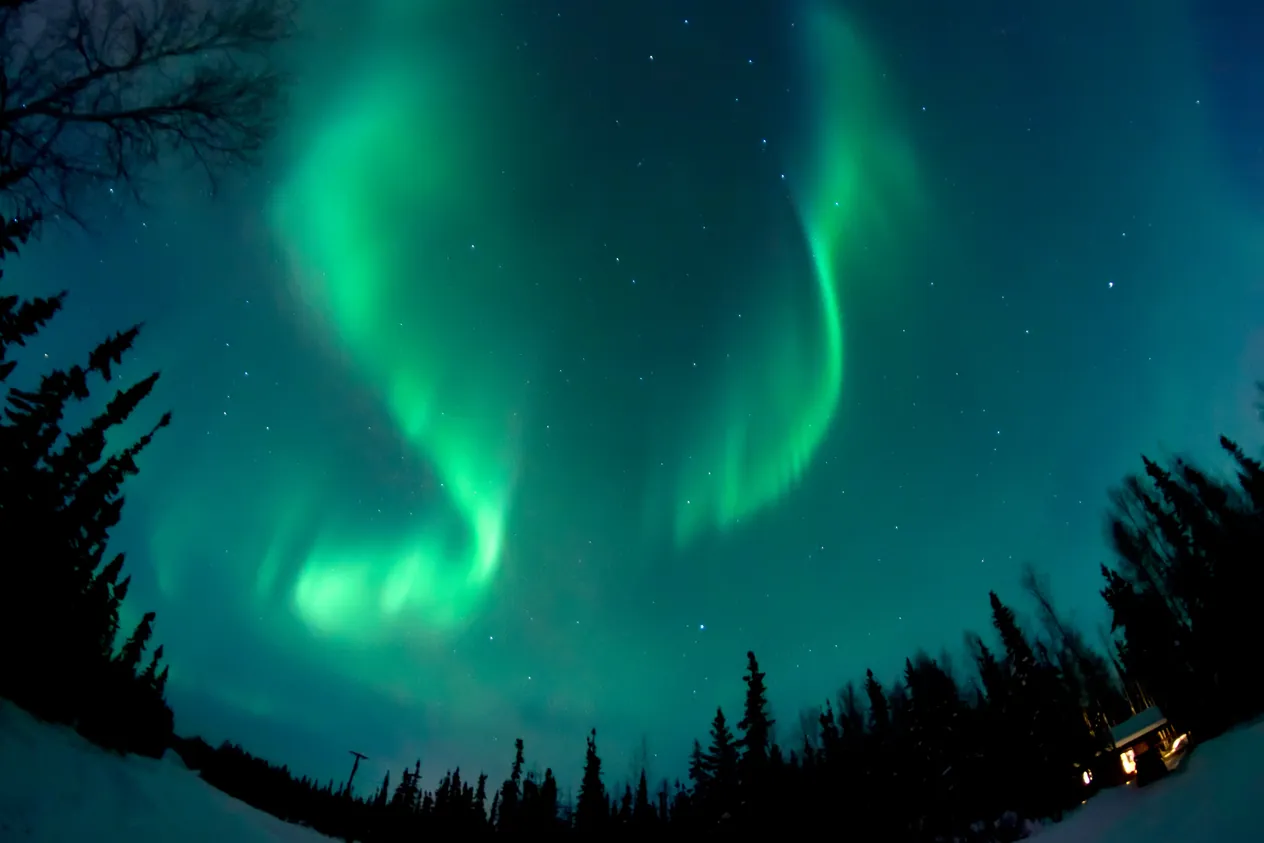
All-sky cameras use a fisheye lens pointed straight up, capturing the entire sky in a single circular image. They’re the best way to monitor overall auroral activity - you can see arcs forming, expansion of the oval, and substorm breakups as they happen. The images are typically colour-coded and update every 10-30 seconds.
The most comprehensive collection is maintained by universities and meteorological institutes. Look for feeds from the Magnetometers - Ionospheric Radars - All-sky Cameras Large Experiment (MIRACLE) network across Fennoscandia, or the THEMIS all-sky imager network across Canada.
Credit: Jason Ahrns
Livestreams
Beyond static webcams, several services offer live video streams - often with commentary or music - during active aurora periods:
- AuroraMAX (Canadian Space Agency) A dedicated HD livestream from Yellowknife that runs nightly during aurora season (September-March). Includes automatic alerts when aurora is detected in the frame.
- YouTube livestreams Search for "aurora live" or "northern lights live" on YouTube. Several operators in Norway, Finland and Alaska run continuous night-sky streams. Quality varies, but during major storms these attract thousands of simultaneous viewers.
- Explore.org Occasionally hosts aurora cameras as part of their nature livestream network.
Livestreams are particularly rewarding during geomagnetic storms. There’s something compelling about watching a substorm breakup unfold in real time, knowing that the light you’re seeing left the Sun days earlier as a coronal mass ejection.
Aurora Alert Apps and Services
You don’t need to stare at a webcam all night. Alert services will notify you when conditions become favourable or when aurora is actively being detected:
Push Notification Apps
- My Aurora Forecast (iOS/Android) - Set Kp threshold alerts for your location. Sends push notifications when geomagnetic activity exceeds your chosen level.
- Aurora Alerts (iOS/Android) - Real-time notifications based on solar wind data, with customisable thresholds for Kp, Bz, and solar wind speed.
- SpaceWeatherLive (iOS/Android/Web) - Comprehensive space weather app with alert options for CME arrivals, geomagnetic storm onsets, and Kp spikes.
- hello aurora (iOS/Android) - Community-driven alerts combining forecast data with real-time sighting reports from users at your latitude.
Email and Social Media Alerts
- NOAA Space Weather Prediction Center: Free email alerts for geomagnetic storm watches, warnings and actual storm conditions. Sign up at swpc.noaa.gov.
- AuroraWatch UK: If you’re in the UK, this Lancaster University service sends email/text alerts when aurora may be visible from British latitudes. Useful for those rare but spectacular low-latitude events.
- Social media groups: Facebook groups, Reddit communities (r/aurora), and X/Twitter accounts dedicated to aurora alerts. These combine automated data with human reports from people who are actually outside looking up.
Set your alerts conservatively at first - a Kp threshold of 5 or above will avoid false alarms while catching most noteworthy events. Lower it as you become more experienced at interpreting conditions.
Reading Space Weather Dashboards
If you want to go deeper than simple alerts, learning to read space weather data yourself is rewarding and not as difficult as it sounds. Here are the key tools:
NOAA SWPC Real-Time Solar Wind (DSCOVR)
The most important single page for aurora watchers. It shows live data from the DSCOVR satellite at the L1 point, approximately 1.5 million km upstream of Earth. The three plots to focus on are:
- Bz (nT): The north-south component of the interplanetary magnetic field. When this goes negative (southward), Earth’s magnetic shield opens and aurora becomes likely. The more negative, the better: -5 nT is mildly favourable, -10 nT is good, -20 nT or below often means a storm.
- Solar wind speed (km/s): Normal is 300-400 km/s. Above 500 km/s is elevated; above 700 km/s is very fast and conducive to strong aurora.
- Solar wind density (p/cm³): Higher density means more particles available to fuel the aurora. A sudden spike often indicates a CME or shock arrival.
The golden combination: fast solar wind + high density + strongly negative Bz = aurora almost guaranteed at high latitudes.
NOAA Ovation Aurora Model
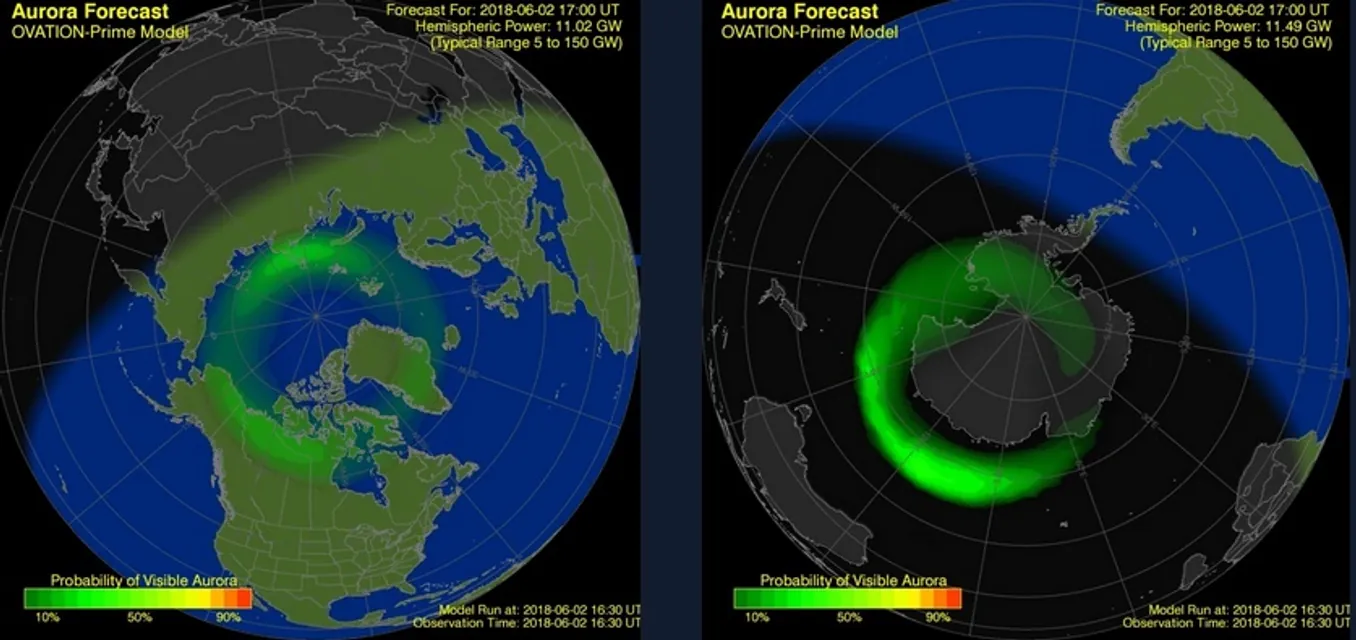
This map shows a real-time estimate of where the aurora is likely visible right now, based on live solar wind data. It displays the aurora oval overlaid on a map of the Northern (and Southern) Hemisphere. If the coloured band extends over your location - or over a webcam you’re watching - aurora should be occurring.
Credit: N0AA Space Weather Prediction Center
The Ovation model is more useful than the Kp-index alone because it shows the spatial extent and intensity of the aurora, not just a single number.
Kp-Index (Estimated and Observed)
The planetary Kp-index is updated every 3 hours by NOAA. For a quick check, the Wing Kp prediction model provides a 1-hour forecast based on current solar wind conditions. If Wing Kp shows 5 or above, it’s worth checking the webcams.
Magnetometer Data
For advanced monitoring, magnetometer stations across the Arctic show real-time disturbances in Earth’s magnetic field. A sudden negative deflection (typically on the X or H component) at a station near your webcam of choice indicates aurora is likely happening overhead right now. The Tromsø Geophysical Observatory and Natural Resources Canada both provide public magnetometer data.
Quick Dashboard Checklist
When you get an alert or want to quickly assess conditions:
- Check Bz - is it negative? The more negative the better.
- Check solar wind speed - is it elevated (>450 km/s)?
- Check the Ovation map - does the oval extend to where your webcam is?
- Check cloud cover at the webcam location - is the sky clear?
- Open the webcam feed and watch.
Making The Most Of Remote Watching
Watching aurora remotely is a different experience from standing beneath it, but it has its own rewards. Here are some tips to enhance the experience:
- Have multiple cameras open: If one location is cloudy, another may be clear. Keep 2-3 feeds from different regions bookmarked.
- Watch during substorms: The most dramatic activity often comes in bursts lasting 30-60 minutes. If magnetometer data shows a sudden drop, switch to your cameras immediately.
- Screenshot and timelapse: Many webcam services archive their images. Revisit them the morning after a storm to see what you missed, or compile them into timelapse videos.
- Join a community: Watching with others makes it more engaging. Discord servers, Reddit threads and Facebook groups come alive during storms, with people sharing screenshots, interpreting data and celebrating together.
- Learn the patterns: Over time you’ll develop an intuition for conditions. You’ll recognise the signature of an approaching CME on the solar wind plots, anticipate substorm timing, and know which cameras perform best in which conditions.
- Use it as preparation: Remote watching is excellent training for a future trip. By the time you stand under the aurora in person, you’ll already understand the forecasting, know what different Kp levels look like, and recognise auroral forms.
When To Watch
Aurora occurs most frequently around magnetic midnight which, depending on the camera’s location, is typically between 22:00 and 02:00 local time. For European cameras, this means late evening through to the early hours UTC. For North American cameras (Alaska, Yellowknife), it means early morning UTC.
However, during strong storms, aurora can persist for many hours and appear well before and after magnetic midnight. If you see alerts for Kp 7+, it’s worth checking cameras at any time during local darkness.
Remember that aurora season runs September to March for most Arctic cameras. Outside these months, the sky simply doesn’t get dark enough. Check our best time of year guide for more on seasonality.
Useful Links
- NOAA Ovation Aurora Map
- NOAA DSCOVR Real-Time Solar Wind
- SpaceWeatherLive
- AuroraMAX (Canadian Space Agency)
- AuroraWatch UK
For current real-time conditions, check our live aurora forecast which combines Kp, Bz, solar wind data on a single page.