Few natural phenomena have been as closely linked to fertility and new life as the Northern Lights. Across centuries and cultures, the aurora has been associated with conception, sexual energy and the blessing of children. Some of these beliefs are rooted in ancient spiritual traditions; others have been embraced, and sometimes embellished, by modern tourism. But the underlying idea persists: that something magical happens when new life begins under the aurora.
East Asian Traditions
Perhaps the most widely cited belief connecting the aurora to conception comes from East Asian cultures, particularly Japan, China and Korea. In these traditions, it is considered highly auspicious to conceive a child under the Northern Lights. The belief holds that children conceived beneath the aurora will be blessed with good fortune, beauty, intelligence and a strong spirit.
This tradition has deep roots. In Chinese cosmology, celestial events were intimately connected to human affairs, and the rare appearance of the aurora at lower latitudes was interpreted as a powerful sign from the heavens. The lights were associated with celestial dragons and divine energy, forces that could bestow blessings on those present during the display.
In Japan, the connection between the aurora and fertility is more subtle but persistent. The lights are seen as a manifestation of cosmic energy, a moment when the boundary between the earthly and the divine grows thin. Conceiving during such a moment is thought to imbue the child with some of that celestial power.
This belief has had a measurable impact on aurora tourism. Hotels in northern Scandinavia, Iceland and Alaska report that Japanese and East Asian guests sometimes request aurora wake-up calls not to rush outside with cameras, but to take advantage of the auspicious timing in private. Some accommodations have learned to be discreet about this; the "do not disturb" sign during an aurora alert has become something of an inside joke among Arctic hoteliers.
Norse and Viking-Era Beliefs
While Norse mythology primarily associated the aurora with Valkyries and the Bifrost bridge, there are threads connecting the lights to fertility and the continuation of life. The Norse worldview saw the cosmos as deeply interconnected: celestial events influenced earthly matters, including the conception of children.
Some scholars have noted that the Vanir, the Norse gods associated with fertility, prosperity and nature, were connected to light phenomena and the heavens. Freya, goddess of love, fertility and beauty, was also associated with the souls of the dead and the afterlife. The aurora’s dual nature (beautiful yet otherworldly, associated with both the living and the dead) mirrors this duality in Norse thought.
In practical terms, the long dark winters of Scandinavia meant that conception during the aurora season (September to March) was common simply by virtue of timing. The cultural association between winter darkness, the lights and new life born the following summer would have reinforced itself naturally over generations.
Inuit and Arctic Peoples
Among some Inuit communities, the relationship between the aurora and conception carried warnings rather than blessings. In certain traditions, pregnant women were cautioned against looking at the Northern Lights or going outside during active displays. The concern was that the spirits within the aurora, often seen as the souls of the dead, might take an interest in the unborn child.
Some communities believed that the aurora could influence the gender or character of an unborn child, or that the spirits in the lights might try to claim the baby’s soul. Pregnant women might wear protective amulets or keep their heads covered during displays as a precaution.
However, not all Arctic traditions viewed the aurora’s connection to fertility negatively. In some Greenlandic Inuit traditions, the lights were the souls of children who had died, dancing joyfully in the afterlife. For those trying to conceive, the presence of these child-spirits could be seen as encouraging rather than threatening, a sign that new souls were near.
Sámi Traditions
The Sámi people treated the aurora with considerable respect and caution. While specific beliefs about conception varied between communities, the general principle of behaving carefully under the lights extended to intimate matters. The aurora was a time of spiritual significance, a moment when the boundary between worlds was permeable, and all important human activities, including those related to creating new life, were understood to carry additional weight.
Some Sámi traditions held that children born during aurora season carried a special connection to the spirit world, a sensitivity to the unseen that could manifest as shamanic ability or heightened intuition.
Medieval European Beliefs
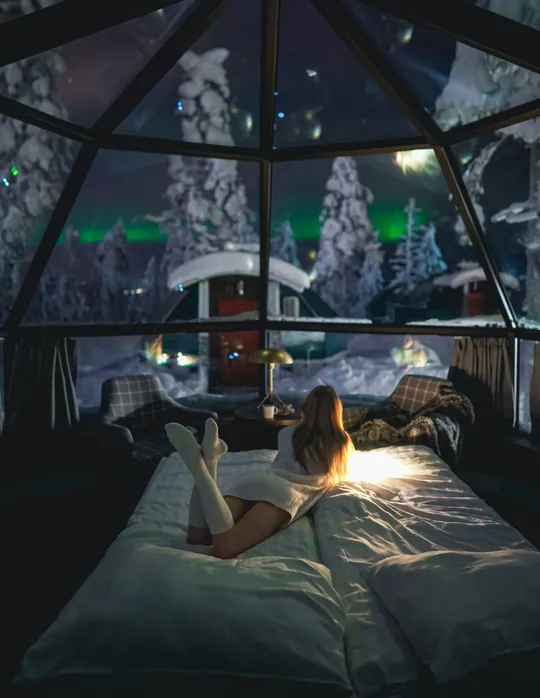
Credit: Illia Panasenko
Glass-roofed igloos and secluded wilderness cabins are marketed with varying degrees of subtlety at couples hoping to combine aurora viewing with conception.
In medieval Europe, where the aurora was rare and often appeared blood-red, the lights were more commonly associated with omens of war and disaster than with fertility. However, the broader medieval understanding of celestial influence on human conception (rooted in astrology and humoral medicine) meant that any unusual celestial event was thought to affect children conceived during it.
Medieval medical texts frequently advised on the optimal celestial conditions for conception. While these typically focused on planetary alignments and lunar phases, the rare appearance of the aurora, interpreted as a sign of exceptional cosmic energy, would have been considered significant by those who witnessed it.
The Modern "Aurora Baby" Phenomenon
In recent decades, the idea of conceiving under the Northern Lights has been enthusiastically adopted by the tourism industry. "Romance under the aurora" packages, glass-roofed igloos and secluded wilderness cabins are marketed with varying degrees of subtlety at couples hoping to combine aurora viewing with conception.
Some of this is driven by genuine cultural tradition, particularly among East Asian tourists following long-held beliefs. But the phenomenon has grown beyond any single cultural origin. The aurora has become a symbol of once-in-a-lifetime magic, and for couples trying to conceive, the idea of doing so during a rare natural spectacle holds powerful emotional appeal regardless of cultural background.
There is, of course, no scientific evidence that the aurora influences fertility or the characteristics of children conceived beneath it. The charged particles responsible for the lights interact with the upper atmosphere at altitudes of 100-500 km, far above any biological effect on the ground. But the absence of a mechanism hasn’t diminished the belief’s appeal, and for many couples the experience carries deep personal significance whether or not they subscribe to any specific tradition.
A Note On Respect
It’s worth acknowledging that beliefs around conception and the aurora are deeply personal and culturally significant. For some, these are living spiritual traditions passed down through generations. For others, they represent a meaningful way to mark an important moment in their lives. The commercialisation of these beliefs by the tourism industry doesn’t diminish their cultural roots.
Whether you view the connection between the aurora and conception as ancient wisdom, romantic symbolism or simply a beautiful coincidence of timing, the underlying human impulse is the same: a desire to connect life’s most profound moments with the wonder of the natural world.
For more on the cultural history of the Northern Lights, see our myths and legends article. For practical advice on planning your aurora trip, visit our planning guide.
Further Reading
- Brekke, A. & Egeland, A. (1983) "The Northern Light in Folklore and Mythology" in The Northern Light: From Mythology to Space Research, Springer Berlin Heidelberg. doi.org/10.1007/978-3-642-69106-5_1
- Lund, K.A. (2016) "Chasing the Lights: Darkness, Tourism and the Northern Lights" in Green Ice: Tourism Ecologies in the European High North, Palgrave Macmillan, pp. 49-71. doi.org/10.1057/978-1-137-58736-7_3